Thursday, 3 December 2015

Cropper pigeon

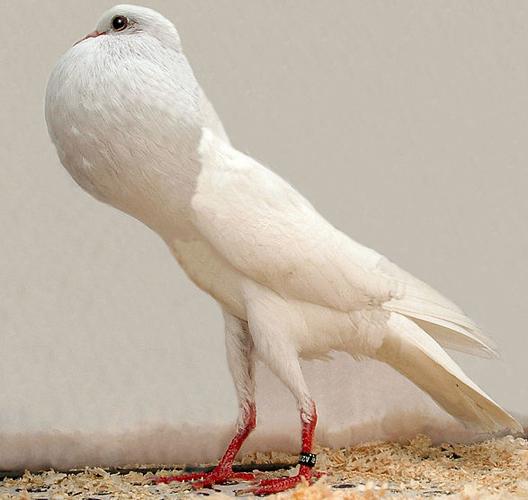
All pigeons inflate their crops (an organ in their throat that grinds up food) while strutting in front of others, but the croppers take this to the extreme. Their crops are highly-developed, and they love to puff their chests out when they’re in play, and not just when they’re trying to find a mate. Despite what looks like a top-heavy bird, the fact that the crop is filled with air means that they’re not going to tip over at any moment. Most Croppers have been bred to have a long back, stand up straight, and for their tendency to puff up. Some have other body shapes, but all are bred with the inflatable crop in mind. These breeds actually have more vertebrae and a larger ribcage than the Rock Dove. Croppers are also some of the more affectionate pigeons, known to bond and play with their handlers.
The Norwich Cropper is a breed of fancy pigeon developed over many years of selective breeding. The Norwich Cropper along with other varieties of domesticated pigeons are all descendants from the rock pigeon (Columba livia).[1] The Norwich Cropper is thought to have been developed from a breed called the Oploper and is of Dutch origin.[2 the Old German Cropper is a breed of fancy pigeon developed over many years of selective breeding. Old German Croppers, along with other varieties of domesticated pigeons, are all descendants from the rock pigeon (Columba livia).[1]
An old breed that originated in Germany and Hungary. Description: The Old German Cropper is the longest breed of pigeon. It has a large well-inflated globe that is oval to round in shape. The old German stands with the front of its body raised in a semierect station and the rest of its body carried close and parallel to the ground. The wings are very long and ideally should extend beyond the tail. They should be well closed and not show a "sail like effect", that is caused by raised secondary feathers that break the smooth wing line. The legs are fairly short without showing the birds thighs that are covered by the undercarriage feathers.
Colors & Markings: The Old German comes in black, white, red, yellow, dun, cream, mealy, silver, blue in bar and check, and lark. They are self-colored, but also can be found in splash or a random mixture of white and colored feathers, tiger which should have dark flights and tail with white feathers sprinkled on the rest of the body, flights marked with a solid colored body and evenly marked white flights on both wings, and mussel head which is primarily found in black which manifests itself with a sprinkling of white feathers on the head reminiscent of the coloring of the shell mussel.

General The overall look of the Old German is large powerful pigeon. Some of this is created by the extreme feather development. The bird does not have a heavy body. Feather development should be smooth and neat without being tight.


Frillback pigeon

These breeds are the earliest known pigeons to be bred solely for ornamental purposes, and not for meat. The curly top flight feathers of these breeds make it appear almost lacy, but come at the expense of effective flight. While they’re able to fly much better than chickens, and can fly “normally” to escape predators or get out of a rut, making some of their flight feathers essentially useless means that to do so, they have to expend more energy than your average pigeon. This factor, along with their larger size, means these birds generally prefer to walk or run, rather than fly. These fancy feathers also mean that the frillback breeds have no water resistance and are highly susceptible to cold if wet, like the fantails. The frillback mutation is autosomal dominant, so if one parent has just one copy of the gene, there’s a 50/50 chance that the offspring will have frilled feathers. The dominance of this gene means that the frill trait has been transferred to some types and families of other fancy breeds
The Frillback is a breed of fancy pigeon developed over many years of selective breeding.[1] Frillbacks, along with other varieties of domesticated pigeons, are all descendants from the rock pigeon (Columba livia). The breed is known for the frill or curls on the wing shield feathers. The feather curl should also be present at the ends of the foot feathers or muffs.[2]

The standards of a pure American Frillback

The quality of a Frillback is based on a 100-point scale, with the head constituting 15 points, the color constituting 15 points, the body constituting 10 points, the curl constituting 50 points, and the muff constituting 10 points.
The colors of standard Frillbacks fall into six color categories.
  1. Self- white, black, recessive red, yellow
  2. Pattern- recessive red mottle, yellow mottle, rosewing, whiteside
  3. Grizzle- red, yellow, blue, silver
  4. Shield marked- red, yellow, blue-black bar, silver-dun bar, mealy ash-red bar, ash-cream bar
  5. ARC- Any rare color
  6. ARCP- Any rare color pattern
ARC and ARCP Frillbacks must be entered by at least 3 exhibitors in 3 of 5 American Frillback shows for 3 years, with judging score progress, before it is deemed appropriate. Frillbacks produce many different colors that are not recognized by the AFC because they are not standard and do not reproduce consistently. Frillbacks can carry numerous colors in many different patterns such as pied. These colors are not recognized as standard, but are very common.
Size Frillbacks are slightly larger than other colored pigeon breeds, with longer tail and wing feathers.
Head Shell-crest and plain-head are found in all colors of Frillbacks. A plain-headed Frillback should have a slightly oval head with no flat areas and a forehead that has a distinct stop at the wattle. A shell-crested Frillback should have a thick shell crest on the back of the head with rosettes on each side. The crest should stand off the head.
Eyes The eyes should be in line with the beak. A reddish-orange is desired in all colors except shield marked. Shield marked desire a black or "bull-eye". While pearl, gravel, and cracked eyes occur, they are not desirable and are considered major faults.
Beak The beak of a Frillback is long, with the upper beak often being slightly longer than the lower beak. The beak is dark on red and blue grizzles, black on blacks, light on yellow, horn on silver, and flesh colored on all other standard colors. The wattle is thin and white on all colors.
Muff The muff of a Frillback will vary, however, 2 to 3 inches is a desirable length.
Frill The curl of a Frillback covers its entire wing shield. No areas should be uncovered. The last row of curls spans the entire length of the wing. Frills form a distinct ringlet curl at the end. The bottom of the muff is also frilled. Tail and flight feathers have a distinct wrinkle.


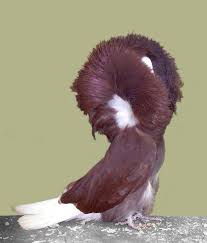
Jacobin pigeon

These were named because of their “mane,” which resembled the cowls of Jacobin monks back when the breed first gained popularity. These days, the mane of most Jacobin types is so pronounced you can’t see the head of the pigeon from the side. Aside from their giant mane, these are slender, shapely creatures, with long legs, a slim tail, and an upright posture. The birds who are most “showy” and who like to fluff up their feathers and strut are highly valued in competition.These were named because of their “mane,” which resembled the cowls of Jacobin monks back when the breed first gained popularity. These days, the mane of most Jacobin types is so pronounced you can’t see the head of the pigeon from the side. Aside from their giant mane, these are slender, shapely creatures, with long legs, a slim tail, and an upright posture. The birds who are most “showy” and who like to fluff up their feathers and strut are highly valued in competition.


scandaroon pigeon

Possibly one of the oldest breeds of pigeon bred for its looks in addition to its utility as a food source, the Scandaroon is believed to date back to the time of Alexander the Great. They have large, downward-curved bills, which are covered by a large wattle (knobby fleshy covering) on top, their eyes are bright and accented, and surrounded by well-developed ceres (a fleshy red ring). They’re part white, or piebald, and larger than your average street pigeon.
The Scandaroon is a breed of fancy pigeon developed over many years of selective breeding.[1] Scandaroons, along with other varieties of domesticated pigeons, are all descendants from the rock pigeon (Columba livia). The breed is also known as a Nuremberg Bagdad.[2]


Bizarre and Beautiful Fancy Pigeons

Fantail

These flashy birds are probably the most recognizable and well-known of the fancy pigeons. Their peacock-like tails, prominent chests, and curved necks are a hit in bird shows and fairground livestock shows around the world. They serve more purpose than just flashiness, though. Racing or homing pigeon breeders often keep fantails at the front of the dovecote while they’re training their new prospects. The highly-visible fantails guide the young ones home like a beacon. Some fantail breeds have less erect tail feathers (such as the Garden Fantails) and are much more capable in flight than the Exhibition Fantails. All of them are missing the oil preening gland at the base of their tails though, so they can be prone to cold when they get wet.


The Fantail is a popular breed of fancy pigeon.[1] It is characterised by a fan-shaped tail composed of 30 to 40 feathers, abnormally more than most members of the pigeon family, which usually have 12 to 14 feathers.[2] The breed is thought to have originated in Pakistan, India, China or Spain. There are several subvarieties, such as the English Fantail, the Indian Fantail, and the Thai Fantail. Charles Darwin used it as one of the examples in the first chapter of On The Origin Of Species.
A Silky Fantail
There is a feather mutation called Silky that gives an interesting lace effect to a Fantails tail feathers.[1] Fantails with this mutation are known as Silky or Lace Fantails.
Fantails are often used by pigeon flyers in the training of racing pigeons and Tipplers. They are used as droppers in that they are placed on the loft landing board as a signal to the flying birds to come in and be fed.


Tuesday, 1 December 2015

The Sylphina Angel (Chorinea sylphina)


The Sylphina Angel is a species of butterfly of the Riodinidae family. It is found in Ecuador, Peru, and Bolivia. Adults fly in full sunshine but occasionally settle beneath the leaves of bushes.

Chorinea sylphina

From Wikipedia, the free encyclopedia
Sylphina Angel
Chorinea sylphina 2.jpg
Scientific classification
Kingdom: Animalia
Phylum: Arthropoda
Class: Insecta
Order: Lepidoptera
Family: Riodinidae
Genus: Chorinea
Species: C. sylphina
Binomial name
Chorinea sylphina
(Bates, 1868)[1]
Synonyms
  • Zeonia sylphina Bates, 1868
  • Chorinea sylphina terpsichore Stichel, 1910
The Sylphina Angel (Chorinea sylphina) is a species of butterfly of the Riodinidae family. It is found in Ecuador, Peru, and Bolivia.
Adults fly in full sunshine, but occasionally settle beneath the leaves of bushes.[2]

Rajah Brooke’s Birdwing (Trogonoptera brookiana)

Rajah Brooke’s Birdwing (Trogonoptera brookiana)
Rajah Brooke’s Birdwing is a distinctive black and electric-green birdwing butterfly from the rainforests in the Thai-Malay Peninsula, Borneo, Natuna, Sumatra, and various small islands west of Sumatra.

Trogonoptera brookiana

From Wikipedia, the free encyclopedia
Raja Brooke's Birdwing
Trogonoptera brookiana 0588.JPG
Adult male (above) and female ventral surfaces
Scientific classification
Kingdom: Animalia
Phylum: Arthropoda
Class: Insecta
Order: Lepidoptera
Family: Papilionidae
Genus: Trogonoptera
Species: T. brookiana
Binomial name
Trogonoptera brookiana
Wallace, 1855
Synonyms
  • Troides brookiana
Rajah Brooke's Birdwing (Trogonoptera brookiana) is a distinctive black and electric-green birdwing butterfly from the rainforests in the Thai-Malay Peninsula, Borneo, Natuna, Sumatra, and various small islands west of Sumatra (Banyak, Simeulue, Batu and Mentawai).[1][2] The butterfly was named by the naturalist Alfred R. Wallace in 1855, after James Brooke, the Rajah of Sarawak.[2]
The larval host plants are Aristolochia acuminata and A. foveolata.[3] Adults sip flower nectar from plants such as Bauhinia.[2]
Rajah Brooke's Birdwing is a protected species, listed under Appendix II of CITES,[3][4] meaning that international export is restricted to those who have been granted a permit.
It is the national butterfly of Malaysia.[5]

Description

Both sexes resemble the more restricted relative, the Palawan Birdwing, but males of Rajah Brooke's Birdwing have more green to the rear wings. The wingspan of Rajah Brooke's Birdwing is 15–17 cm (5.9–6.7 in).[3]
The wings of males are mainly black. Each forewing has seven teeth-shaped electric-green markings, while there is a relatively large electric-green patch on the hindwings. The head is bright red and the body is black with red markings. The wings of females are browner with prominent white flashes at the tips of the forewings and at the base of the hindwings.[3]

Taxonomy

genus: Trogonoptera Rippon, 1890
  • Trogonoptera brookiana Wallace, 1855
Trogonoptera brookiana brookiana (Wallace, 1855)
Trogonoptera brookiana brookiana f. brookiana Wallace, 1855
Trogonoptera brookiana brookiana f. julijae S.Hu, 2007
Trogonoptera brookiana toshikii Kobayashi, 1991
Trogonoptera brookiana akikoa Morita, 1994

Illustrations